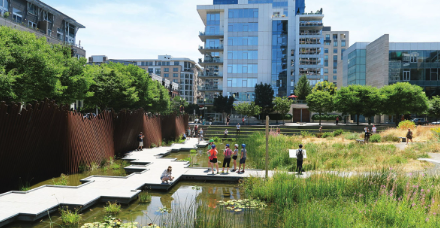
Blue-Green Infrastructure (BGI), often designated as Sustainable Urban Drainage Systems (SUDS), represents a critical opportunity to deliver multifunctional spaces and urban adaptation with sustainable water management at its core. Nevertheless, the social aspects of BGI remain under-explored, with socio-technical perception representing a signicant “implementation gap”. While surveys are commonly utilized to gather data, they oftenlack robust mathematical and statistical analyses to draw reliable results. This research applies Partial Least Squares and Structural Equations modeling (PLS-SEM), using the SmartPLS tool, to examine practitioners’ knowledge of BGI and how it affects perceptions of costs-benecits, barriers, and opportunities for implementation. A questionnaire comprising 7 sections and 51 questions was administered to 261 international practitioners from 24 countries and 3 continents specialized in BGI. Findings suggest that, within the institutional and climatic contexts represented in our sample: (1) demographics and regional/cultural characteristics signicantly influence results; (2) BGI is perceived as critical urban environmental practice for climate resilience; and (3) inte-
grating community-based factors is key to overcoming the BGI implementation gap. The validated structural model confirms the established hypotheses and provides a transferable decision-support methodology to inform environmental policymakers and practitioners.